
 RRL
 Freenote Cloth
 Merz B. Schwanen
 Red Wing
 Hiroshi Kato
 Schott NYC
 UES Clothing
 Dehen1920
 Polo Ralph Lauren
 West Major
 Shinola
 Amundsen
 MOSCOT
 Peregrine
 Shangri-La Heritage
 Astorflex
 Iron and Resin
 Ampal
 Jungmaven
 Big D Speedshop
 Fulton & Roark
 Howler Bros
 AO Eyewear
 Rails
 Ranger Station
 Bellroy
 Filson
 Sabah
 Birdwell
 Secrid
 Taschen
 Schwood
 Bradley Mountain
 American Trench
 Studebaker Metals
 Unmarked
 Texas Standard
 Rhythm
 Oxford Pennant
 Gestalten


 Girls of Dust
 Road to Nowhere
 Filson
 Marine Layer
 Rails
 THE GREAT.
 Shinola
 Diadora
 Astorflex
 Retro Brand

Type I, Type II, Type III: The Levi's Denim Jacket, Sorted
Three jackets, sixty years, and a handful of details — a pocket here, a buckle there — that separate them. Plus the Japanese book that documented every stitch, and why a copy is sitting on our shelf in Phoenix.

The book at the center of this story: Levi's Vintage Denim Jackets Type I / Type II / Type III (World Photo Press, 2020) — on our shelf in Phoenix.
01 — The Names Came Later

The world these jackets were made for: a working man in a dungaree coat, photographed for the Farm Security Administration in 1941. (Library of Congress.)
Here is the first thing to know about the Type I, Type II and Type III: Levi's never sold a jacket under any of those names. When the jackets were new, they were work clothes with lot numbers — 506, 507, 557 — bought by miners, railroad men and cowboys who wore them until they fell apart, and then bought another. Nobody at Levi Strauss & Co. sat in a meeting and approved a “Type II.”
The names are a collectors' invention. In the 1980s, as vintage American denim became a serious market in Japan, dealers and collectors there needed a shared language for the ways the Levi's jacket had changed across the decades. So they sorted it into three types, in order, and the shorthand stuck so completely that Levi's own archivists use it today. It stuck because the differences are real. Each type is a distinct answer to the same question — how should a denim work jacket be built? — asked in a different era, and each one can be told from the others at a glance once you know where to look: the chest pockets, the pleats, and what's happening at the back waist.
Levi's has been making denim jackets since the 1870s, when the company's riveted “blouses” went to work alongside the original waist overalls. The three types below cover the jacket's classic half-century, from the early 1900s to the 1960s — the run that every denim jacket made since, by any brand on earth, is still measured against.

The book lays the jackets out year by year — 1930s, 1942, 1950, 1962, 1966 — so the changes read like a flip book.
02 — Type I — Lot 506, the Original

A mid-1930s Type I, worn to pieces and photographed the way it was found. The white tag under its leather patch dates it — the book reads details like that the way other people read serial numbers.
The Type I is the jacket in its first settled form: Lot 506, in XX denim, made from roughly 1905 until 1953. Count the chest pockets. There is one, on the left, and for its first decades that was enough — the earliest examples don't even have a flap on it. Run your eye down the front and you'll see the other signature: two pleats, stitched down in rectangular box tacks, running from the yoke toward the waist. The pleats weren't decoration. They were ease — room to reach, lift and swing built into a garment with no stretch in it.
The construction is hardware-store honest. Copper rivets reinforce the pocket corners, the same rivets Levi's had been hammering into work clothes since the 1870s. The fit is short, wide and unapologetic — a blouse, really, cut to be worked in over whatever a man wore underneath. And at the back, the detail collectors look for first: a cinch strap with a metal buckle across the lower back, so the wearer could pull the waist in. The early buckles had prongs, and cowboys hated them — the prongs scratched saddles, truck seats and furniture — so after the war the buckle lost its teeth, though the cinch itself carried on to the end of the run.

The book's back cover is a cinch back — the Type I's calling card, and the first thing collectors check.
The Type I changed in small ways across its five decades, and those small ways are how you date one. The little red tab arrived on the pocket in 1936 — before that, nothing. Wartime models, built under material restrictions, lost the pocket flap and some of their buttons. A blanket-lined version showed up around 1950 for men working in real cold. But the recipe never moved: one pocket, pleats, rivets, cinch. When Levi's finally replaced it in 1953, the Type I had been in production, in one form or another, for close to fifty years. Good originals are now among the most valuable production garments in the vintage world — and they were never meant to be anything but a shirt for men who worked outside.
03 — Type II — Lot 507, the Short Run

An original 1950s 507XX, faded the honest way: two flap pockets, the pleats kept, and not a rivet in sight. (Photo: Blue Truck, Fukuoka.)
In 1953 Levi's modernized the jacket, and the Type II is what modernization looked like in 1953: symmetry. A second chest pocket appeared, mirroring the first, both now with flaps. The front pleats stayed — the jacket still had a job to do — but two things quietly disappeared, and they're the tells. The cinch back was deleted, replaced by small button adjusters on the waistband at each side: cleaner, cheaper to make, and nothing on the back to scratch a saddle. And the copper rivets at the pocket corners gave way to bar tacks, rows of dense stitching doing the same work with thread instead of metal.
The Type II kept the family silhouette — short, boxy, pleated — and that is exactly why it's the connoisseur's jacket. It is the transitional fossil: half work blouse, half modern trucker, made for only nine years, 1953 to about 1962. Short runs make for rare survivors, and the 507 has become one of the hardest Levi's jackets to find in honest condition. If the Type I is the founder and the Type III is the celebrity, the Type II is the one the serious collectors quietly hunt.
04 — Type III — Lot 557, the Trucker

A 1960s 557XX: pointed flaps, V-shaped seams, Big E tab — the silhouette that became “the denim jacket.” (Photo: Second Sunrise.)
At the start of the 1960s — Levi's Archives date Lot 557 to 1961, renumbered 70505 a few years later — the jacket was redesigned from the pattern up, and this time nothing was carried over out of sentiment. The pleats were deleted outright. In their place, two seams sweep down the front in a long V from the pointed pocket flaps, shaping a jacket that is visibly slimmer, longer and sharper than either of its ancestors. The two chest pockets sit higher, their flaps cut to a point. The waist adjusters stayed, the boxy blouse fit did not. This is the silhouette the world now means when it says “denim jacket” — the one that picked up the nickname “trucker,” the one every fashion house on earth has copied, and the one Levi's still sells, essentially unchanged, more than sixty years on.
The Type III's own dating game runs on details: the red tab carried a capital E — LEVI'S, the famous “Big E” — until about 1971, when it became the small-e tab, and collectors price that single letter accordingly. But the deeper point is that the Type III is where the work jacket finished becoming a style garment. A Type I was bought by the man who worked in it. A Type III was bought by everybody.
The spotter's cheat sheet
TYPE I · LOT 506 · c.1905–1953 — One chest pocket. Front pleats. Cinch buckle at the back. Rivets on the pocket. Short and boxy.
TYPE II · LOT 507 · 1953–1962 — Two chest pockets. Front pleats. Button adjusters at the waist, no cinch. Bar tacks instead of rivets. Still boxy.
TYPE III · LOT 557 / 70505 · 1961–today — Two chest pockets with pointed flaps. No pleats — V-shaped seams instead. Waist adjusters. Slimmer and longer: the trucker.

The book's dating grid: pocket shapes, button faces, back buckles and rivets, each pinned to its years. This is how a jacket with no label still gets a birthdate.
Three questions, in order, will sort almost any vintage Levi's jacket you'll ever pick up: How many pockets? Are there pleats? What's at the back waist? Everything after that — tabs, buttons, buckles, patches — is dating, and dating is a deeper rabbit hole than most people expect. Which is where the book comes in.
Levi's never called them Type I, II and III. Collectors did — and the names stuck because the differences are real.
05 — The Book That Wrote It Down

The cover is a Type I front, printed like denim and bound like a jacket. Two hundred pages, printed in Japan in 2020.
In 2020, two Japanese collectors and dealers, Yutaka Fujihara and Naoki Kawamata, published Levi's Vintage Denim Jackets Type I / Type II / Type III with World Photo Press in Tokyo. Between them they had spent decades buying, selling and studying vintage Levi's, and the book is what that obsession looks like in print: 200 full-color pages documenting the jacket's evolution at the level of collar shapes, stitch counts, button faces and patch printings.
Thirty-four Japanese collectors lent their own jackets to be photographed — pieces so rare that the editors admitted some were new even to them. Levi's itself opened the door: the company's Archives supplied period catalog imagery and sat with the editors to confirm the design variations, down to the oldest jacket in the company's possession, an 1870s Triple Pleat Blouse that predates the types entirely. It is, as far as anyone can tell, the first book ever devoted entirely to the details and dating of these jackets. Fujihara and Kawamata had form: five years earlier they made The 501 XX: A Collection of Vintage Jeans, the same treatment for the jeans, which has been a reference-shelf fixture ever since.
The catch, for Americans, is distribution. The book was published for the Japanese market — Japanese text with English captions throughout — and it was never properly distributed in the United States. Copies surface here one at a time, through importers and secondhand listings, usually at a markup and usually gone quickly.
06 — On Our Shelf

The companion volume: The 501 XX: A Collection of Vintage Jeans (2015), by the same editors.
Which is the part where we get to say something we don't get to say often: we have it. Cave & Post is one of the very few shops in the United States carrying Levi's Vintage Denim Jackets Type I / Type II / Type III — we import it directly from Japan, along with its companion, The 501 XX. The jacket book is $175 and the 501 XX book is $165, in the shop and online, and when this printing is gone there is no promise of another.
If you're passing through Phoenix, ask to flip through it at the counter before you commit. Ten minutes with the dating grid will change how you look at every vintage jacket on every rack for the rest of your life — including ours. That's really what these two books are: the training course for your own eye, written by the two men who may know these garments better than anyone alive.
One pocket, two pockets, trucker. Now you know — and if you want the other two hundred pages, they're on our shelf.
Sources & further reading: Tracey Panek, “Levi's® Vintage Denim Jackets Detailed in New Book,” Levi Strauss & Co. (2020); Rivet & Hide, “Jackets 101: The Real Difference Between Type I, II, and III Denim Jackets”; DC4 Berlin, “Denim Jackets — A Look at the Evolution of Style”; the books themselves, on the shelf at Cave & Post. Book photographs are our own, of the copies in the shop. Working-man portrait: Farm Security Administration, Library of Congress (public domain). Type II photograph: Blue Truck, Fukuoka. Type III photograph: Second Sunrise.
Read more

PoloFest Tokyo, and the Labels That Made Polo
For three days last weekend, Harajuku became the capital of vintage Polo. The festival Ralph Lauren threw in Tokyo was really a family reunion — every label the company ever made, gathered under o...
Read more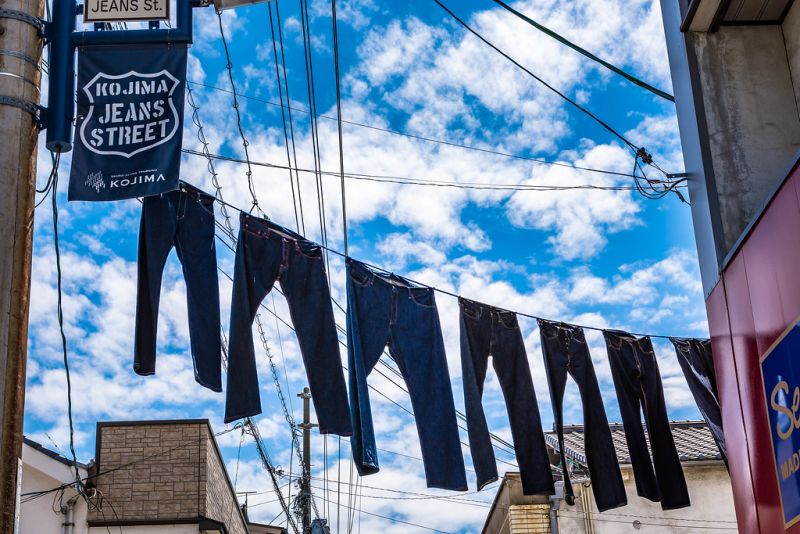
The Osaka Five and the Town That Sewed Japan's Jeans
In the eighties, five Kansai brands set out to rebuild the American jean better than America was building it. Two hours west, a school-uniform town had been quietly sewing Japan's jeans since 1965...
Read more
Leave a comment
This site is protected by hCaptcha and the hCaptcha Privacy Policy and Terms of Service apply.