
 RRL
 Freenote Cloth
 Merz B. Schwanen
 Red Wing
 Hiroshi Kato
 Schott NYC
 UES Clothing
 Dehen1920
 Polo Ralph Lauren
 West Major
 Shinola
 Amundsen
 MOSCOT
 Peregrine
 Shangri-La Heritage
 Astorflex
 Iron and Resin
 Ampal
 Jungmaven
 Big D Speedshop
 Fulton & Roark
 Howler Bros
 AO Eyewear
 Rails
 Ranger Station
 Bellroy
 Filson
 Sabah
 Birdwell
 Secrid
 Taschen
 Schwood
 Bradley Mountain
 American Trench
 Studebaker Metals
 Unmarked
 Texas Standard
 Rhythm
 Oxford Pennant
 Gestalten


 Girls of Dust
 Road to Nowhere
 Filson
 Marine Layer
 Rails
 THE GREAT.
 Shinola
 Diadora
 Astorflex
 Retro Brand
Article: A Knife Is a Tool, Not a Trophy

A Knife Is a Tool, Not a Trophy
On keeping an edge — and why the knife that matters is the one you can maintain.

Somewhere in your house there is a knife you no longer reach for.
It was sharp once. They all are, the day they arrive. But somewhere along the way it stopped biting and started pushing, and a knife you have to push is a knife you work around rather than with. So it migrates — to the back of the drawer, the bottom of the pack.
Nothing is wrong with it that twenty quiet minutes wouldn't fix.
A dull knife asks for force. A sharp one asks for nothing.
That is the whole safety argument, and it is also the whole pleasure argument. A sharp knife goes where you point it and stops when you stop. It does not skate off the tomato skin or slip out of the rope. It simply works, and in working well, it disappears.
What remains is the hand, and the task.
What happens to an edge
An edge fails in two ways, and neither is dramatic.
Mostly, it bends. The edge on any knife is thinner than you can see, and thin things fold. Meet a bone, a frozen joint, the rim of a pan, and the last fraction of the blade rolls quietly to one side. The steel is still there. It is only out of line — and it can be stood back up on a leather strop or a honing rod, the way you would straighten a bent nail. This is most of what “dull” usually is.
Or the edge wears. Stroke by stroke, year by year, the point where the two sides meet rounds away entirely. No rod fixes that. Worn steel has to be removed, gently and evenly, until the sides meet again.
Stone for what's worn. Leather for what's bent.
That is the entire discipline. Everything else is repetition.
The grind that teaches you

There is a reason the Scandinavian knife is where so many people learn this.
Most blades carry a small second bevel at the edge — a tiny angle you must hold freehand, at fifteen degrees or twenty, the same on every stroke, while the stone does its work. It is a skill, and skills take time to settle into the hands.
The scandi grind has no second bevel. One wide, flat slope runs from the body of the blade straight to the edge. To sharpen it, you lay that slope flat on the stone — and the angle is simply there, registered, impossible to lose without feeling it go. The bevel becomes its own guide.
The stone already knows the angle. Your hands just have to listen.
It is the grind Helle has used in Holmedal, Norway, since 1932, on the working knives — the Harding, the Gro, the Eggen. It favours control over force. And it means the person who owns the knife can also be the person who keeps it, which has always seemed to be rather the point.
Twenty quiet minutes

Soak the stone. Work slowly, edge first, in long strokes that use the whole blade, heel to tip. You are not scrubbing. You are shaving a layer of steel so thin it barely exists.
After a while — you will feel it before you understand it — a fine wire rises along the far side of the edge. Run a fingertip across the blade, never along it, and there it is: the burr. It is the proof that you have ground all the way to the edge, along its whole length. Turn the knife over and do the same for the other side.
Then lighten your hands. A few strokes each side, half the pressure, until the wire lets go.
Finish on leather. A strop if you have one, the back of a belt if you don't — spine first, edge trailing, a dozen unhurried passes. Stropping is not sharpening. It is polishing. It is the edge, stood up straight and left clean.
Then a sheet of paper, held in the air. A sharp knife takes it in one quiet curve, without tearing, without sound worth mentioning.
Not sharp enough to shave with. Sharp enough to trust.
There is a small stone made for exactly this — double-sided, coarse on one face and finer on the other, in a leather holster, small enough to live in a pack. It exists because edges are best kept where they are used: a little, often, in the field, rather than rescued once a year at a bench. Maintenance is not a project. It is a habit, like oiling boots.
Steel, without the mythology

Steel invites exaggeration, so it helps to keep the terms few.
Hardness is a trade. Harder steel holds an edge longer and gives it back more reluctantly; softer steel dulls sooner and returns in minutes. The working knives of the world mostly settle between those failures, and so does Helle.
Their 12C27 — a Swedish stainless, the steel of the Gro and the Eggen — is not exotic. But it is dependable. It holds an edge well, resists corrosion, and can be maintained without difficulty. For a knife likely to be used often, and in varied conditions, that matters more than novelty.
The laminated steels are the older Norwegian answer to the same question. A hard core that takes a keen edge but might, alone, be brittle — jacketed in softer steel that flexes, and will not rust, and will not let the core break. Helle has made theirs since the 1960s, from a recipe the family patented in 1967. The stainless version rides in the Harding. The carbon version, in the Viking, takes the finest edge of all — and asks, in return, to be dried and oiled and not put away wet. It will rust if not maintained. The listing says so, plainly. There is something honest in a tool that tells you its terms up front.
And in the kitchen, the Dele — Helle's first chef's knife in sixty years, its name meaning to split and to share — follows the same thinking with a different grind, flat rather than scandi, because an onion is not a tent peg. Same stone. Same strop. Never the dishwasher.

The first knife

Helle has made a scout knife — the Speider, with its red butt — since 1947, and their thinking about it is worth borrowing whole. A child's first knife should not be a toy version of a knife. It should be a proper tool, sharp and real, with a guard for small hands — because the most important safety mechanism is not the guard. It is the training.
To learn to use a tool, you need a proper tool to work with.
A sharp knife teaches a light hand. A dull one teaches force, which is the one lesson you never want taught. Whittling stick, adult close by, cut away from yourself, sheath it before you walk. Several generations of Norwegians have been onboarded on exactly this curriculum.
On our racks
Twelve Helle models arrived at the shop this month — the Harding and the Arv in laminated steel, the Viking in carbon, the Gro, Eggen, and Speider in 12C27, the Dele for the kitchen, and the little field stone in its leather holster to keep all of them honest.
They arrive, as Helle puts it, sharp right out of the box.
Keeping them that way is not a chore added to ownership. It is most of what ownership means.
A tool is not defined by what it can do at its limits, but by how often you choose to use it. And you choose the one that cuts.
Photo credits: Product and lifestyle photography via Helle (us.helle.com).
Read more
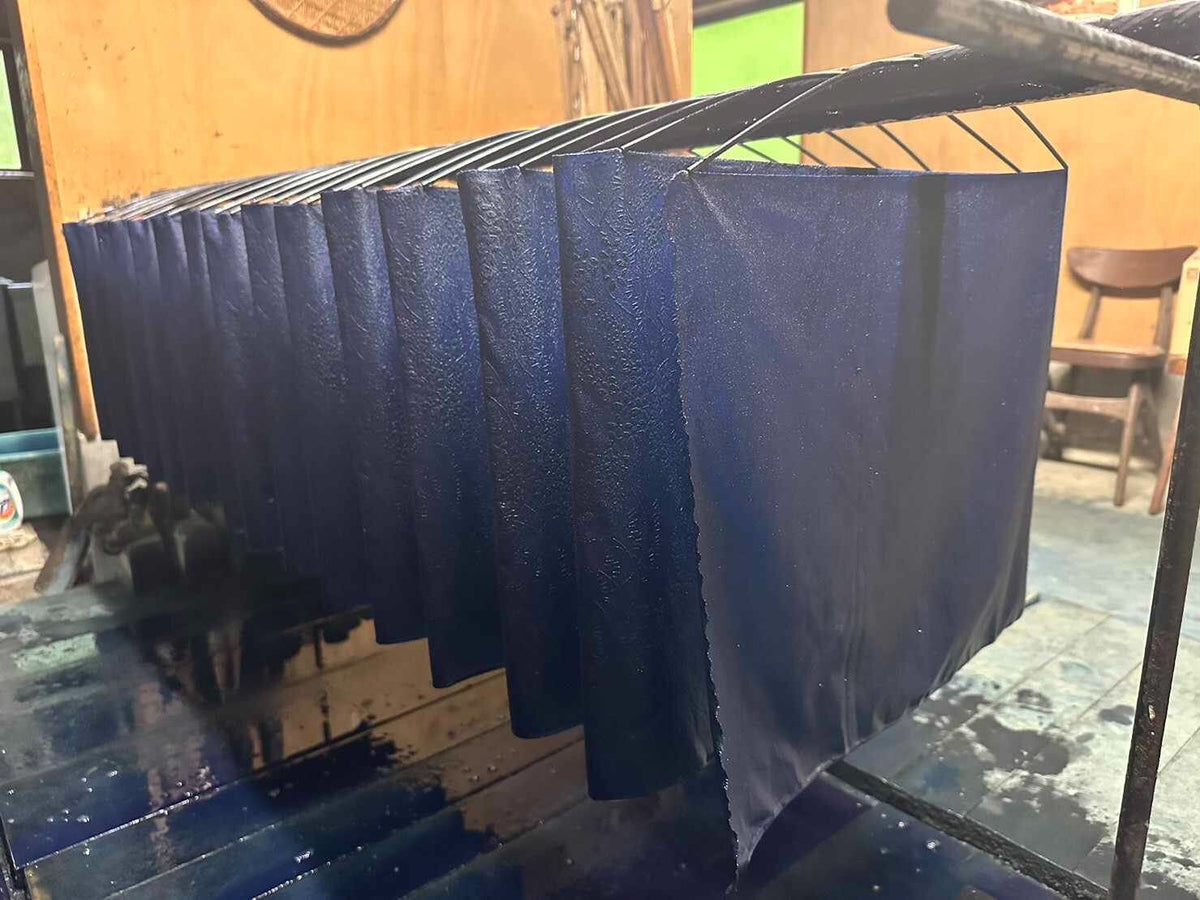
Indigo is the oldest blue in the world, and it has never learned to hold on. Six thousand years of dyers, bans, plantations, and one very large factory bet — plus a single chemical quirk — explain ...
Read more
Leave a comment
This site is protected by hCaptcha and the hCaptcha Privacy Policy and Terms of Service apply.